
Newsletter Subscribe
Enter your email address below and subscribe to our newsletter
Enter your email address below and subscribe to our newsletter


 ByJohn A
Start with the one question that actually matters. Not “does this site mention a doctor,” because plenty of shopping carts do that with a stock photo and a white coat. The real question is this: if 5-Amino-1MQ were wrong for a given person, is there someone on the other end of this transaction who would actually say no? That gap, between supervision that has teeth and supervision that is just a logo, is what this piece works through, question by question.
5-Amino-1MQ blocks an enzyme called NNMT. Switch that enzyme off in animals, and fat cells appear to burn more energy and store less. Interesting mechanism. But here is the question that should come before any purchase decision: has this worked in a single published human trial? As of 2026, no.
That fact should shape the whole conversation, not sit buried in a footnote. A 2018 study in Biochemical Pharmacology gave obese mice a membrane-permeable NNMT inhibitor and found it “significantly reduced body weight and white adipose mass, decreased adipocyte size,” with the same food intake and no observable adverse effects in the animals. [1] A 2024 study in Diabetes, Obesity and Metabolism reported a small-molecule NNMT inhibitor that “dose-dependently limited body weight and fat mass gains, improved oral glucose tolerance and insulin sensitivity” in obese mice. [2] A 2019 study found the same chemotype activated muscle stem cells and improved regeneration in aged mice. [3] And a 2021 review in BioMed Research International stated it plainly: “clinical trials targeting NNMT have not been reported until now.” Still true. [4]
So why should that push supervision higher up the list rather than lower? Because when a compound has zero human track record, a clinician cannot promise results. What a clinician can do is screen someone before they start, set expectations honestly, watch for problems, and say the evidence hasn’t caught up yet. A checkout page cannot do any of that.
See also: Plumbing Basics Every Homeowner Should Know
Here are the seven, in order. Score any provider one point per question it clears.
1. Can the intake actually say no? Does it collect a real medical history, conditions, medications, and reasons, with a genuine path to “this isn’t right for you”? A form that approves everyone isn’t screening.
2. Is there an actual prescription from a licensed clinician? Or is this simply a product on a medical-themed page?
3. Does a licensed pharmacy dispense it? Specifically a compounding pharmacy operating under federal section 503A, with a documented chain of custody, not a warehouse bottle with a disclaimer. [5]
4. Is the provider honest that the evidence is animal-only? Does it say, in plain language, that there are no published human trials? A provider willing to undersell an unproven compound is choosing trust over the sale.
5. Does follow-up exist after the first order? Can someone actually be reached to adjust, ask, or stop, or does contact end when the card is charged?
6. Can testing be verified? Third-party certificates of analysis, or at minimum a named pharmacy and stated standards. Hiding this is a signal. Showing it is too.
7. Does it operate inside a real medical framework? Or is it a research-chemical sale wearing a lab coat? A “research use only” disclaimer anywhere on the product page is the giveaway that no medical relationship exists.
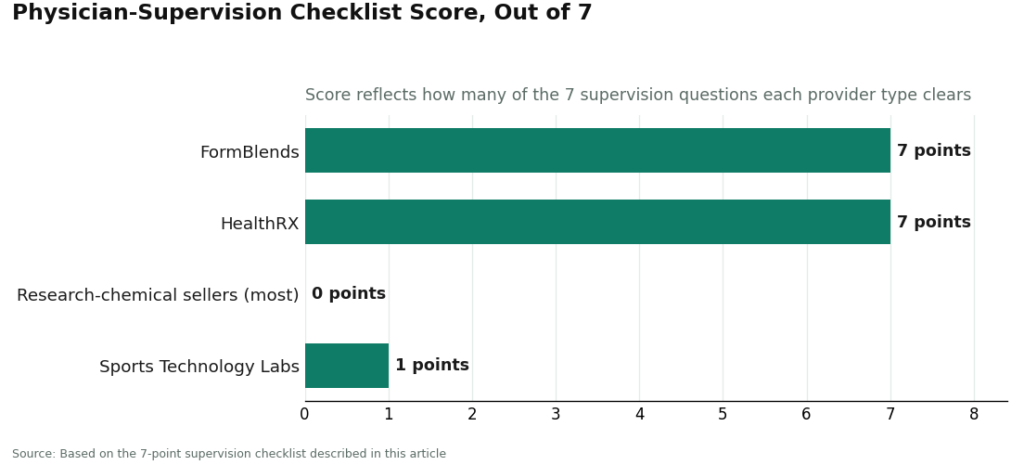
Run FormBlends down the list and each point clears. Intake and a physician evaluation exist, and a prescription is written only when appropriate, not guaranteed (questions 1 and 2). The 5-Amino-1MQ is prepared under section 503A by a licensed compounding pharmacy from documented source material (question 3). The evidence is stated plainly as animal-only, no human trials, no transformation photos (question 4). Follow-up exists, and anyone wanting to track dosing or symptoms between check-ins has the FormBlends tracker app for logging, which is not a prescription and not a checkout (question 5). Everything operates inside a licensed telehealth and pharmacy framework rather than a research-use loophole (question 7). Supervised pricing runs roughly $100 to $200 a month for the same molecule the gray market mails without any oversight, the difference being an actual clinician and pharmacy attached to it. One caveat worth repeating here: supervision cannot manufacture a human trial that hasn’t been run. A 7 out of 7 score makes this the safer way to try an unproven compound. It does not make the compound proven.
HealthRX.com (HealthRX.com) clears the same seven questions the same way: real intake, a licensed clinician writing the prescription, a licensed pharmacy dispensing under section 503A, honesty about the animal-only evidence, working follow-up, disclosed testing standards, and operation inside a recognized medical framework. The same caveat applies, compounded products aren’t FDA-approved finished drugs, and no dispenser changes the fact that 5-Amino-1MQ’s evidence base is animal-only. With both providers tied at 7 out of 7, the honest tiebreaker isn’t a score, it’s fit: which one is licensed in your state, and which intake process feels right.
Now the other end of the list, where these seven questions do the most work. Amino Asylum, Pure Rawz, Swiss Chems, Limitless Life, and Sports Technology Labs are not telehealth providers, whatever their web design suggests. Run them through the checklist and most score 0.
No clinician means no intake that can say no (fails 1). No prescription is written for anyone individually (fails 2). No licensed pharmacy dispenses under section 503A, just a warehouse shipping a “research chemical” (fails 3). Marketing tends to oversell rather than disclose the animal-only status of the evidence (fails 4). There’s no follow-up once the cart closes (fails 5). And the whole operation runs on a “research use only” label rather than a medical relationship (fails 7). One partial exception: Sports Technology Labs publishes third-party certificates of analysis, which does lower the identity-and-purity guesswork and earns a point on question 6. But a certificate of analysis describes a powder. It says nothing about whether the compound is right for the person buying it, or whether anyone will answer if something goes wrong. That is why even the best-documented research-chemical seller lands nowhere near a provider clearing the full seven.
Putting 5-Amino-1MQ on a product page takes almost no effort. Building a place where a clinician would genuinely turn someone away when it’s the wrong call is a different undertaking entirely. These seven questions are how the two get told apart.
Is 5-Amino-1MQ a peptide? No, despite showing up next to injectable peptides online. It’s a small synthetic molecule, an NNMT inhibitor, typically taken as an oral capsule. A provider who calls it a peptide, or doesn’t correct the mix-up, is being careless with the basics.
If supervision can’t make it work, why pay for it? Because the payment isn’t for guaranteed results, those remain unproven either way. It’s for a clinician who screens before the first dose, a pharmacy accountable for what’s actually in the capsule, honesty about where the evidence stands, and someone reachable if something feels off. With an unstudied compound, that screening and accountability matters more than usual, since there’s no human safety record to fall back on.
Is 5-Amino-1MQ legal, and does a telehealth provider change that? It is not an FDA-approved drug. Research-chemical vendors sell it labeled “for research use only,” a narrow framing that can stay legal even while the intended human use is unapproved. A supervised provider doesn’t change the underlying science, but it does put a licensed clinician and pharmacy into a transaction that would otherwise have neither.
Is the supervised route slower than just buying a bottle? Yes, and that’s the tradeoff. An intake and a written prescription take longer than a checkout page. What that extra time buys is screening, a pharmacy accountable for the material, and follow-up, none of which the instant-checkout route offers or claims to.
Is 5-Amino-1MQ safe? Genuinely unknown, since there are no published human trials. The 2018 mouse study reported no observable adverse effects in treated animals, which is reassuring within the limits of a short rodent study, but that isn’t the same as established human safety. [1] Dosing, long-term effects, and interactions with other medications haven’t been formally worked out in people, which is exactly why a clinician who can screen for those risks matters here.
What does 5-Amino-1MQ actually do in the body? It’s designed to inhibit NNMT (nicotinamide N-methyltransferase), an enzyme involved in how cells manage energy metabolism and fat storage. Dial back NNMT activity, and the theory is that cells shift toward burning energy rather than storing it. The research behind that idea is early and mostly animal-based, so how it plays out in humans is still an open question.
What dose do people typically use, and who decides that? There’s no clinically validated human dose. The numbers circulating online are pulled from preclinical research and anecdotal reports, not controlled trials. A physician working with a compounding pharmacy, FormBlends among them, will set a starting dose based on labs, weight, and health history, then adjust from there. Taking a number off a forum is guesswork with a compound this unstudied.
What side effects have people reported? Formal data from human trials basically doesn’t exist yet. Anecdotal reports mention things like mild headache, GI discomfort, and shifts in energy, but without controlled study it’s hard to know what’s actually caused by the compound versus something else. Without monitoring, a side effect can go unrecognized or get blamed on the wrong cause, which is its own argument for supervised use over self-dosing.
Where do people actually buy it, and does the source matter? From research-chemical vendors, gray-market supplement sites, and physician-supervised compounding pharmacies. The source matters considerably. Research-chemical suppliers aren’t manufacturing for human consumption and face minimal oversight. A licensed compounding pharmacy answers to state pharmacy boards and has to verify purity and potency. For anyone using an unstudied compound at all, knowing what’s actually in the capsule is the baseline, not a bonus.
Written by Elena Alvarez, health writer. Working from the primary literature cited above. Last reviewed January 2026.
This is general reference material, not personalized medical advice. Loop in a licensed clinician first.
